
Two copper-aluminium sheets can both be 2 mm thick and still contain very different amounts of copper. If your enquiry gives only the total thickness, suppliers may quote different constructions. The prices then become difficult to compare.
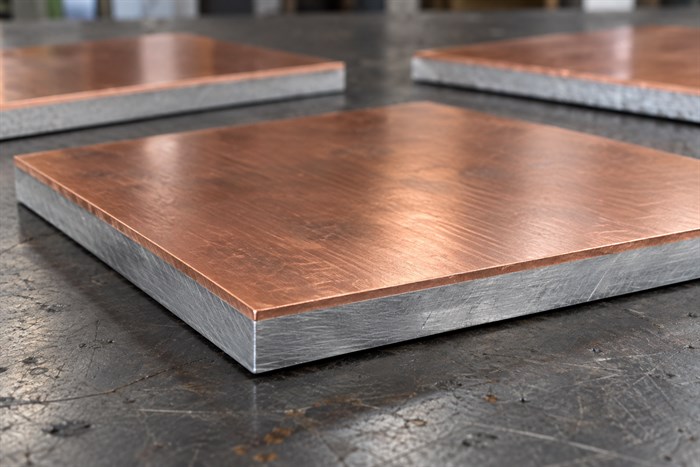
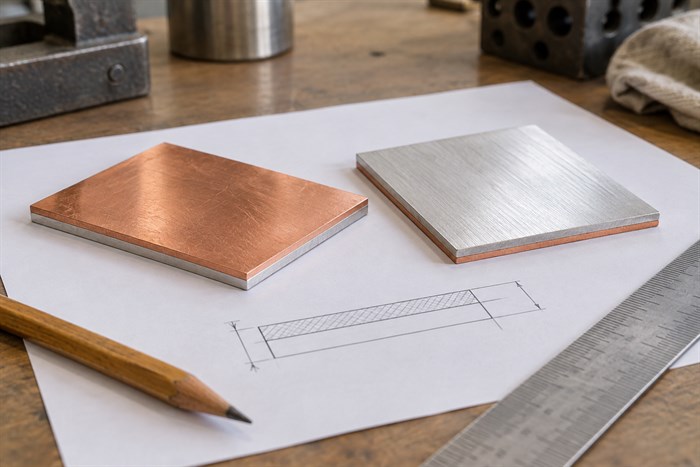
Specify copper layer thickness, aluminium layer thickness and total thickness separately. Show which face is copper, state the permitted variation, and explain whether the dimensions apply before or after machining. A small cross-section drawing makes a copper aluminium bimetal sheet thickness requirement much easier to understand.
1. Show what sits inside the total thickness
For a simple two-layer sheet with no additional layer or coating, the calculation is straightforward:
The two examples below have the same overall thickness. However, Example B has twice the nominal copper thickness of Example A.
Example A · 10% copper
Copper, top face: 0.20 mm Aluminium, bottom face: 1.80 mmExample B · 20% copper
Copper, top face: 0.40 mm Aluminium, bottom face: 1.60 mmAt equal sheet area, B contains twice the nominal copper volume. That can affect the quotation, but it does not mean the finished sheet costs twice as much. Processing, order quantity, material grades and inspection requirements also matter.
Write percentages with a clear basis. In these examples, copper percentage means copper thickness divided by total thickness, multiplied by 100. It is not copper percentage by weight. The EMS copper-clad aluminium brochure also expresses its layer ratios by thickness. Do not assume every quotation uses that convention.
For copper on both faces, label each copper layer separately. A single combined copper percentage does not tell the supplier how much belongs on each side.
2. Set limits for the dimension that matters
Nominal thickness is the target value. Tolerance is the permitted variation around that target. If the copper layer must never fall below a particular thickness, state a minimum explicitly.
Total thickness controls fit
It tells you whether the sheet fits the available space. It does not, by itself, confirm that enough copper is present.
Copper thickness controls the copper allowance
A separate layer limit lets you check the copper needed at the specified stage of production.
For example, 0.15 mm copper plus 1.85 mm aluminium still equals 2.00 mm. If a drawing requires at least 0.18 mm of copper, that construction fails the copper requirement despite matching the nominal total. These numbers illustrate the check; they are not suggested acceptance limits.
Make the limits work together. Copper and aluminium thickness add up to the total. Ask the drawing owner to make the limits consistent and identify any dimension shown only for reference. NPL’s engineering drawing and measurement guide explains the relationship between drawing requirements, tolerances and measurement.
3. Say when and where thickness is checked
Will the copper face be ground, milled or polished after delivery? Tell the supplier. The copper thickness on the incoming sheet and the copper remaining on the finished part are different requirements.
If your process removes copper, specify the minimum needed afterwards and discuss the incoming allowance. Do not choose a universal extra thickness: the amount removed and the variation in your process determine what is needed.
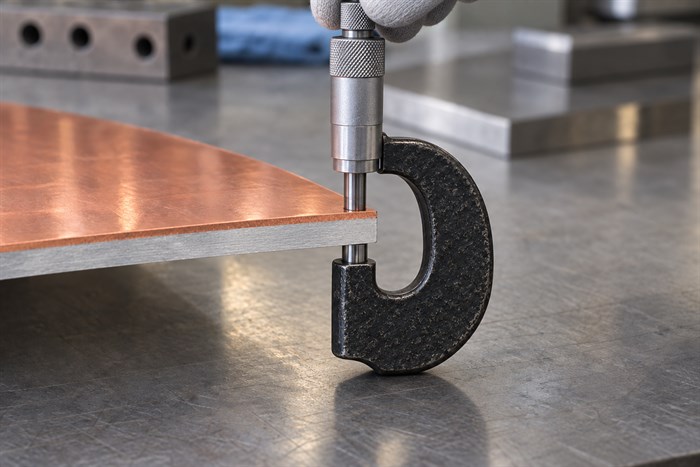
An ordinary outside micrometer reads the total thickness; it does not separate the copper and aluminium layers. Agree how individual layers will be measured, where measurements will be taken, and how many pieces will be checked. Ask the supplier to state this in the quotation.
4. Turn the layer drawing into a clear RFQ
An RFQ is a request for quotation. Use the following worked example to organise yours. The sizes and quantity are fictional, and the example requests a preliminary quotation rather than defining a finished purchase specification.
| RFQ field | Example entry |
|---|---|
| Layer order | Top: copper. Bottom: aluminium. Copper covers the full face. |
| Nominal thickness | Copper 0.20 mm + aluminium 1.80 mm = total 2.00 mm. |
| Size and quantity | 100 mm wide × 200 mm long; 200 sheets. |
| Delivery condition | Uncoated sheets. Thickness applies at delivery; no planned face machining. |
| Materials | Supplier to identify proposed copper and aluminium grades and material condition for buyer approval. |
| Limits and checks | Supplier to propose achievable thickness limits, dimensional tolerances and layer inspection method. Buyer to approve before ordering. |
Please quote 200 single-sided copper-aluminium sheets, 100 × 200 mm, with nominal copper thickness 0.20 mm, aluminium thickness 1.80 mm and total thickness 2.00 mm. The copper must cover one full face. Supply uncoated; dimensions apply at delivery.
Please identify the proposed material grades and condition, achievable thickness limits, layer measurement method and sampling plan. List any alternative layer construction separately. Please also state price basis, lead time and quotation validity. Material suitability and final tolerances remain subject to our approval before ordering.
Before comparing prices: check that both offers describe the same layer order, thickness split, materials and acceptance limits. If one supplier changes any of these, treat it as an alternative offer. Add your application, drawing revision and any forming or joining steps to the real enquiry.
Frequently asked questions
Can I specify only total thickness and copper percentage?
Only if the percentage basis, layer arrangement and acceptance limits are clear. Writing the individual layer thicknesses in millimetres alongside the ratio makes misunderstandings easier to spot.
Does the correct thickness prove that the layers are well bonded?
No. Dimensions and bond quality are separate requirements. State the bond inspection or test requirements needed for your application and agree the acceptance criteria before placing the order.
Should plating be included in the total thickness?
Say explicitly whether the total applies before or after plating. List any added coating separately so that copper-cladding thickness is not confused with a surface finish.
Have a layer drawing ready?
View our copper-clad aluminium plate and sheet page, then send the layer thicknesses, sheet dimensions, quantity and intended use with your enquiry.
EMS: Copper Clad Aluminum, “Ratio” section — layer-ratio terminology.
NPL: Design and interpretation of engineering drawings for measurement processes, GPG79 — drawing and measurement guidance.