
CCA busbars · A buyer’s guide
“Copper content” needs a basis: thickness, cross-sectional area or weight.
Copper clad aluminum (CCA) busbar copper content cannot be compared from a percentage alone. Copper layer thickness measures a distance; area percentage measures copper’s share of a cut end; weight percentage measures copper’s share of the bar’s mass. These numbers describe different things.
Before comparing quotations, ask which basis is used and which faces carry copper. This guide shows the difference with one simple calculation, then gives you wording to use in an enquiry.
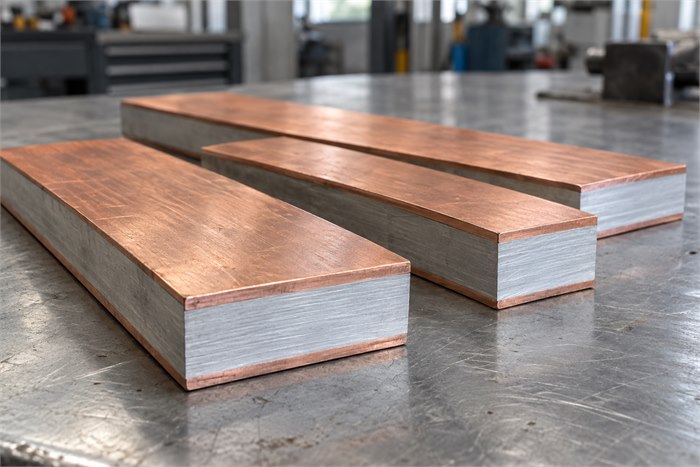
1. What does each copper figure tell you?
Layer thickness: “0.25 mm per face”
This is the depth of copper on a named face. It does not state how much of the whole bar is copper. Ask whether the figure applies to each face, and whether it is nominal, average or minimum thickness.
Area percentage: “5% by area”
Imagine cutting straight across the bar and looking at the end. Divide the copper area by the total metal area. For a uniform section continuing along the same length, this also equals the copper volume percentage.
Weight percentage: “14.78% by weight”
This is copper mass divided by total metal mass. Copper is denser than aluminum, so its weight percentage is higher than its area percentage in a bar containing these two metals.
The useful question
“Can you show the copper-covered faces on the drawing and state whether the percentage is by area or by weight?” A labelled section is much clearer than an unexplained “copper ratio”.
For a copper clad aluminum busbar enquiry, request the layer arrangement alongside the outside dimensions. A copper-coloured surface alone does not tell you the layer thickness or the copper share.
2. One bar, three different answers
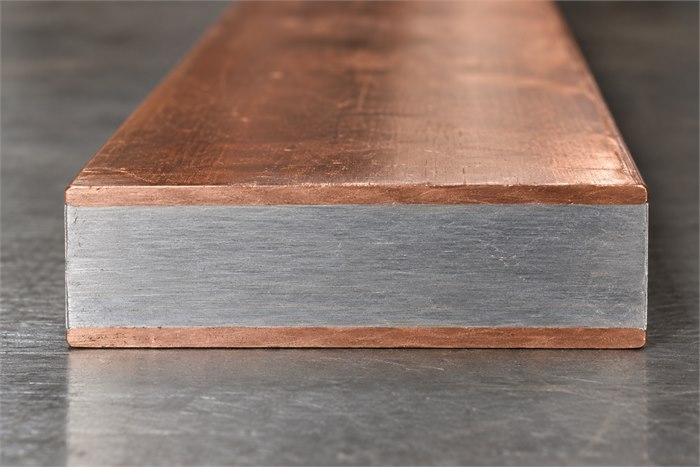
Illustrative calculation, not a product specification: assume a rectangular bar measuring 50.0 mm wide × 10.0 mm thick, with a uniform 0.25 mm copper layer on each broad face. The two narrow edges have no copper. Ignore rounded corners, holes, coatings and the small transition region where the metals meet.
9.50 mm
First, calculate the copper area
The whole cut end has an area of 50 × 10 = 500 mm². Each copper layer occupies 50 × 0.25 = 12.5 mm². Two layers therefore occupy 25 mm², leaving 475 mm² of aluminum.
Then, allow for the different metal weights
For this example, use reference densities of 8.90 g/cm³ for copper and 2.70 g/cm³ for aluminum. Aurubis lists 8.9 g/cm³ for Cu-ETP/C11000; thyssenkrupp lists 2.70 kg/dm³, equivalent to 2.70 g/cm³, for EN AW-6061 at 20°C. These are calculation inputs, not a claim that these grades form the supplied CCA busbar. Use the agreed grades and density values for an order. See source 1 and source 2.
Take a one-metre length. With area in mm² and density in g/cm³, multiplying area × density × 0.001 gives mass in kg/m.
| Material | Calculation | Mass |
|---|---|---|
| Copper layers | 25 × 8.90 × 0.001 | 0.2225 kg/m |
| Aluminum core | 475 × 2.70 × 0.001 | 1.2825 kg/m |
| Total | 0.2225 + 1.2825 | 1.5050 kg/m |
3. Does “15% copper” mean the same thing in two quotes?
No. Using the same reference densities, the two statements below describe very different copper shares. These are calculated comparisons, rounded to two decimal places.
Quote A: 15% copper by area
For every 100 mm² of section, 15 mm² is copper. Its calculated copper share by weight is 36.78%.
Quote B: 15% copper by weight
For every 100 kg of metal, 15 kg is copper. Its calculated copper share by area is only 5.08%.
To convert area to weight, multiply each metal’s area by its density, then divide the copper result by the combined result. To convert weight to area, divide each metal’s mass by its density, then compare the resulting volumes for the same uniform length.
Convert both quotations to one agreed basis before comparing price. Copper percentage alone also does not establish the busbar’s current rating: the electrical design still needs checks for the actual dimensions, connections and operating conditions.
4. What should you put in an enquiry?
Specify outside width × total thickness × length, identify every copper-covered face, and state the copper thickness requirement. If you also use a percentage, name its basis and how it will be checked.
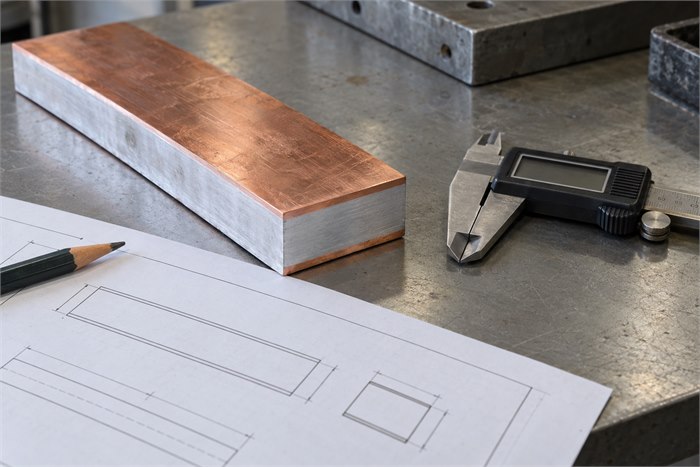
Copy and adapt this example
“Please quote CCA busbars to the attached drawing. Outside section: 50.0 × 10.0 mm. Copper on both broad faces only; narrow edges unclad. Proposed nominal copper thickness: 0.25 mm per face. Please confirm available grades, thickness tolerances and minimum local thickness, measurement locations and method, and the calculated copper percentage by area. State density inputs for any weight percentage. Required length, quantity and application: [insert project details].”
Replace the example dimensions with your design requirements. Agree whether acceptance is based on nominal values, an average or a minimum at specified locations; an average alone does not define the thinnest permitted point.
Frequently asked questions
Can I use the same calculation if copper covers all four faces?
The area method still works, but the geometry changes. For the same 50 × 10 mm outside section with an ideal uniform 0.25 mm layer all around, subtract the 49.5 × 9.5 mm core from 500 mm². Copper area becomes 29.75 mm², or 5.95%. Real corner shapes must follow the drawing.
Can weighing a finished busbar prove the copper percentage?
Weighing alone gives total mass, not separate copper and aluminum masses. A calculation needs reliable geometry and material data. Ask for an agreed verification method, and allow for holes, coatings and other features before comparing finished weight with a simple rectangular model.
Does an “8:2 ratio” tell me enough?
No. Ask which metal comes first and whether the ratio refers to area, volume or weight. Also distinguish the copper layer’s share of the composite from the copper purity of the layer material; these are different specifications.
Make the copper requirement clear before requesting a price
Send your drawing, application, quantity and required lengths through the busbar enquiry form. Mark the copper-covered faces and the percentage basis so the proposed construction and inspection requirements can be discussed against the same specification.
Sources and further reading
1. Aurubis Finland: Material properties for pure copper and low-alloyed copper. Cu-ETP/C11000 density: 8.9 g/cm³. Used only as a reference input for the illustrative calculation.
2. thyssenkrupp Materials Services: EN AW-6061 material data sheet, MX/TIS_06.2018, page 3. Reference density: 2.70 kg/dm³ at 20°C. This source does not specify the core grade of a CCA product.