
Cable connection selection guide
A lug can fit the bolt and still be wrong for the cable.
To choose a bimetallic cable lug size, match the conductor material, nominal cross-section and conductor type first. Then check the equipment stud size, actual lug-hole diameter and available mounting space. Before ordering, confirm the installation tooling and application requirements with the supplier.
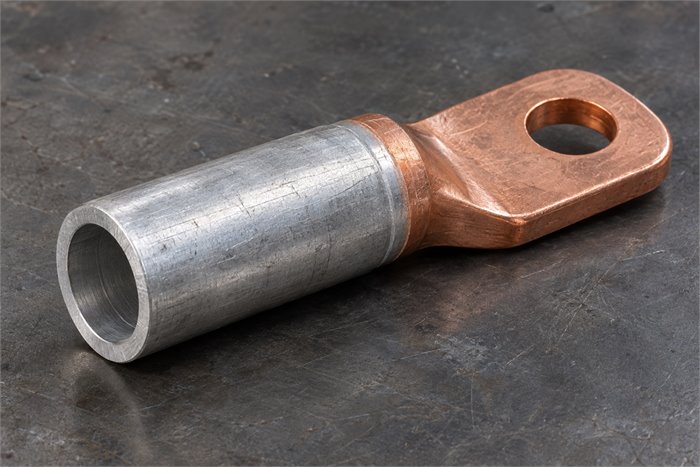
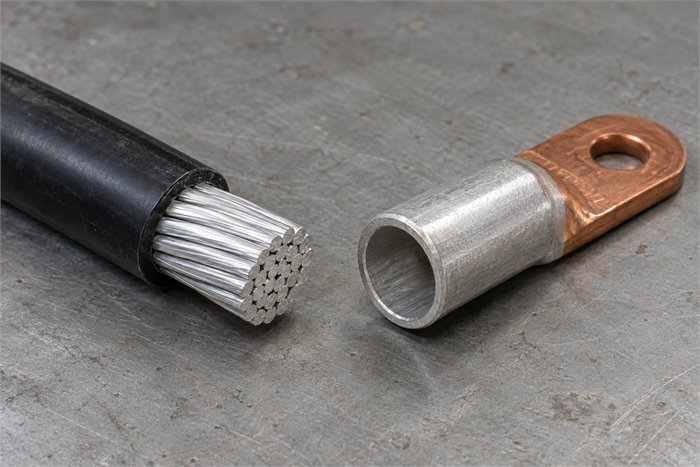
This guide covers compression-type aluminium-to-copper lugs: an aluminium cable enters the barrel, and the copper palm bolts to a suitable copper connection. The barrel is the tube around the cable; the palm is the flat mounting pad.
1. What cable information does the supplier need?
Start with the cable datasheet or cable marking. “95 mm² aluminium cable” is useful, but it does not fully describe the conductor that must fit inside the lug.
Material and cross-section
State aluminium or copper, then the nominal conductor area in mm². Cross-section describes the conductor metal, not the outside diameter of the insulated cable. Do not select a lug by measuring the insulation.
Construction and shape
Confirm solid or stranded, round or sector-shaped, and whether the conductor is compacted. Class 1 means solid; Class 2 means stranded. If the cable is flexible, ask specifically whether the lug accepts that conductor class.
These details matter because a lug's stated cable size can depend on conductor construction. For example, Elpress lists its AKK95-12 for 95 mm² stranded aluminium or 120 mm² solid aluminium. That is a rating for this particular product, not a rule for every lug.
Klauke's Al/Cu lug range likewise distinguishes conductor classes and shapes, and specifies preparation requirements for sector conductors. Ask for the exact product's approved conductor range rather than relying on a similar-looking part.
2. Does an M12 stud need a 12 mm lug hole?
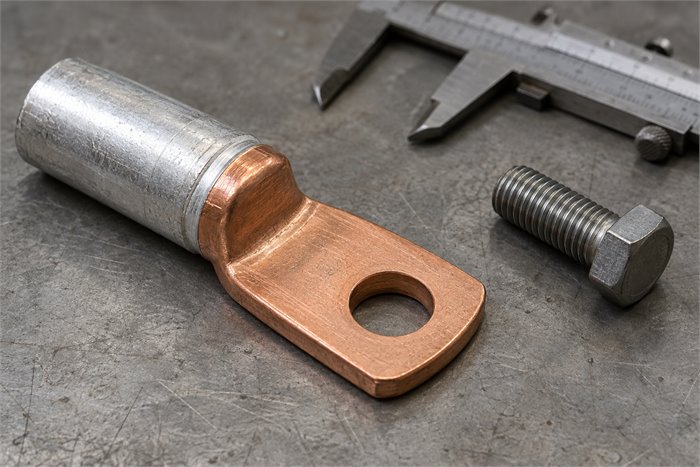
Not necessarily. M12 identifies the nominal metric thread size of the stud. The lug drawing gives the actual clearance-hole diameter. For example, Cembre's CAA95-M12 table lists an M12 stud connection with a 13 mm hole. Check the selected product drawing; do not apply that dimension to every M12 lug.
Also check the palm width, its length and the hole position. A lug may pass over the stud yet overhang the contact surface, foul a neighbouring connection or leave too little room for the installation tool.
Send the equipment terminal drawing where possible. It should show the mounting surface, stud arrangement and nearby space restrictions. Ask the supplier to confirm the proposed lug against it.
3. Which candidate passes the first selection check?
The comparison below uses a fictional enquiry: 95 mm² round, Class 2 aluminium conductor connected to a copper terminal with an M12 stud. The candidates illustrate a selection method, not actual supplier models.
On a small screen, swipe the table sideways.
| Candidate listing | Decision | Reason / next action |
|---|---|---|
| 95 mm², Class 2 round Al; M10 | Reject for this enquiry | The listed stud size does not match M12. |
| 95 mm², solid Al only; M12 | Reject for this enquiry | The cable is stranded, outside the stated conductor approval. |
| 95 mm², Class 2 round Al; M12 | Continue checking | Confirm the hole and palm dimensions, tooling and service requirements before approval. |
The rule: a mismatch in material, conductor area, approved conductor type or stud size stops selection. A match makes the lug a candidate; it does not approve the complete electrical connection.
4. What else should be confirmed before ordering?
Ask for the exact lug part number and drawing, plus its installation instructions. Confirm the compatible crimping tool and dies—the shaped inserts used by the tool. The instructions should specify preparation, strip length and crimping requirements. Elpress provides product-specific tool matching, illustrating why a cable-size label alone is insufficient.
State the equipment voltage, indoor or outdoor location, moisture exposure and any project test-document requirements. Obtain the applicable bolted-joint tightening instructions from the equipment and connection suppliers. Do not borrow a torque or crimp setting from an unrelated lug.
If the supplier proposes an alternative, compare its drawing, conductor approvals and tooling requirements again. A similar catalogue description is not enough to establish interchangeability.
A clear enquiry you can adapt
This fictional example is a starting point for a quotation. Replace the brackets and attach the documents before sending.
Subject: Al/Cu compression lug enquiry — 95 mm² cable, M12 stud
Quantity: 200 pieces.
Cable: aluminium, 95 mm², Class 2, round; compacted status [confirm]. Cable datasheet [attach].
Equipment connection: copper terminal, M12 stud. Terminal drawing and available space [attach].
Service: indoor equipment; rated voltage, moisture exposure and project requirements [specify].
Installation tool: [give make/model, or request a compatible tool recommendation].
Please confirm the proposed part number, approved conductor types, actual hole diameter, palm dimensions and compatible tooling. Please provide the installation instructions and identify any relevant test documents available for this exact product and connection arrangement.
Frequently asked questions
Are all lugs marked “95-12” interchangeable?
No. Check what those numbers mean in each manufacturer's catalogue. Even where they indicate cable size and stud size, conductor approvals, palm dimensions and tooling can differ.
Can I order a larger barrel just to make insertion easier?
Only if the manufacturer explicitly approves that lug for the actual conductor. Loose physical fit does not demonstrate that the specified crimp will produce a suitable connection.
Does matching the cable area confirm the current rating?
No. It is one selection check. The complete connection must satisfy the equipment's electrical and thermal requirements under the actual installation conditions.
Turn two size numbers into a usable enquiry
Review the aluminium-to-copper lug product page, then send your cable datasheet, terminal drawing and quantity. Ask for a proposed part and the supporting details above before confirming the order.